In this tutorial, Robert, an ex-examiner takes the IELTS Reading test.
The structure of the IELTS Reading question
I did Reading Passage 3 of Test 1 of the Official Cambridge Guide to IELTS. A long text, very long. Nine paragraphs on the subject “Is Photography Art?”.
Three sets of questions. Fourteen questions in total.
- Questions 27 to 30, multiple-choice.
- Questions 31 to 34 consist of a summary where you are given a number of words to fill in to complete it.
- Questions 35 to 40, 6 matching questions where you have to relate 5 artists and art critics mentioned in the passage to a series of statements of the kind “who thought or said what?
I’ve always believed this particular sort of IELTS Reading question in the final section to be rather tricky.
The third reading passage in IELTS Academic is always a little longer, the questions on it a little more complex and you’d probably be well advised to find more than 20 minutes to do it.
An ex-examiner shares how to tackle the IELTS Reading test exercise:
- I read the title of the passage “Is Photography Art?”, and skimmed the first paragraph, noticing that it appeared to refer to the early days of photography
- I spent a few seconds looking over the rest of the passage, noticing how it seemed to mention quite a few “names”.
- I went to the questions. Read what I had to do. Here I’m going to skip the first two tasks and concentrate on the Matching one.
- I read each statement to get a good idea of each one, underlining the keyword in each one. For example:
35. He claimed that photography would make painting more realistic. (keywords: painting more realistic because of photography)
36. He highlighted the limitations and deceptions of the camera. (keywords: camera limitations and deceptions)
5. Now, I thought it much easier to then take each of the five persons mentioned. These are placed in the order they appear in the text. The statements are jumbled, not of course in a sequence. So, it was logical to look at each person and relate what it says to the statements.
6. This seemed to work. For example, the second person mentioned – Francis Wey- “suggested that they (I.e photographs) would lead to greater naturalness …..”. Let me read that part from the text.
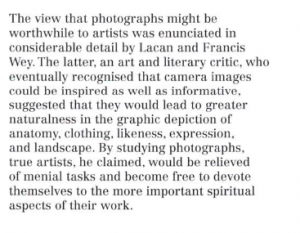
That idea of “naturalness” I connected in 35 to “make painting more realistic”. So, I put 35-B /Francis Way
This process of reading and relating, a mixture of scanning and close reading /attention to keywords I repeated for all the others mentioned. Result? I did it. I admit I felt under pressure and of course, became aware once again of how distractors work. Statements that might lead to a different conclusion because they contain some – but not all – the “truth”, as in 36 which refers to “limitations” (more than one person mentioned pointed that out) but the key here was “deceptions” which referred to only one of the five.
An ex-examiner’s score after taking the IELTS reading test
As I mentioned before it took me 19 minutes but I didn’t have time to re-check the answers. Well, I guess I had one minute but I just sat there staring at the screen.
14 questions: 13 correct answers!!!
Yes, I got one wrong! And, yes, it was in the Matching activity. Question 38
- He noted the potential for photography to enrich artistic talent.
I answered with the same Francis Wey, jumping too quickly at the link between “enrich talent” and “camera images could be inspired” …I was wrong of course. A source of inspiration has nothing necessarily to do with making someone more talented.
Tips for IELTS Reading success
- Pay very, very close attention to the wording of the questions.
- Don’t imagine for one moment that this is anything else than an exam exercise, a test of your ability to find information in a text quickly and to do so on the basis of your knowledge of vocabulary, especially of synonyms and paraphrasing.
Join many other students who have achieved success with our online IELTS prep course. Click here to enrol now.
You can download or listen to the audio version here:
| Direct Download Here | Stitcher | iTunes | Spotify |
Podcast: Play in new window | Download
Subscribe: RSS