In this tutorial, we discuss how to answer True-False-Not Given questions in IELTS Reading with ex-IELTS examiner Robert.
The two types of reading test questions a lot of IELTS test-takers find tricky are the True – False and Not Given questions.
We often see a variation of the True/False/Not Given statement in the second or third reading passage namely, Yes/No/Not Given when you are asked to compare a series of statements with the author’s claims or views.
In other words, we have here two quite distinct purposes behind these two question types.
What is a True-False question in IELTS Reading?
In true or false reading questions, we have to look at the factual information in the text and ask ourselves the following question:
- Is there evidence to confirm that the statement is true or does it contradict what is written and is therefore false?
This type of question is often used at the beginning of the reading test. This suggests that it shouldn’t be that hard. The reading texts and the questions based on them get progressively more difficult.
So, what’s the problem here? Most people agree that it’s the Not Given option.
What is a Not Given question in IELTS Reading?
What happens is that the Not Given statement will contain some information which is mentioned in the text but it is not enough to determine if the entire statement is either true or false. This is done quite simply by using words – phrases that are in the text itself.
In theory, it looks like a simple enough task. As the test taker, you must ask yourself:
- Is there sufficient information in the text so we can neither confirm nor deny it?
What we also see is the mention of something that we might expect to find in the text but in fact, isn’t there at all.
Realizing that something is not there, that it’s Not Given requires a little more effort than just the binary true-false options. You have to make sure and do a double check to be certain you are right.
Sample True-False Question and Answer
Let’s take an example. It comes from the Cambridge IELTS 16 test collection, in particular Test 3, Reading Passage 1, questions 1 to 5.
Here are the first two questions:
- The Romans’ shipbuilding skills were passed on to the Greeks and the Egyptians.
- Skilled craftsmen were needed for the mortise and tenon method of fixing planks.
Here’s how to approach the reading test. It’s a question of exam technique. Moving from question type and question statement to the text. Skimming the text for a general impression, scanning it for specific details and, most importantly, knowing exactly where in the text to find the information you need.
In this case, it’s right there from the start. Questions 1 to 5.
Well in question 1, the grammatical relationship between the Subject (The Romans’ shipbuilding skills), verb (were passed on to) and object (the Greeks and the Egyptians). So, who did the “passing on “of these skills? Well, the Romans. The verb is passive but it’s because it’s the “skills<” we’re talking about. So, it was the Romans who “passed on”, that is, gave or taught, these skills “to” others, namely, the Greeks and the Egyptians.
Does the text say that?
In the next question, the verb is also passive but the point perhaps here is in the connection between this strange method of fixing planks and the need for skilled craftsmen to do it. Every word counts sometimes. We place so much stress in IELTS reading on speed and skimming but it is important here with this type of question to weigh the significance of each word.
Read the relevant part of the text below.
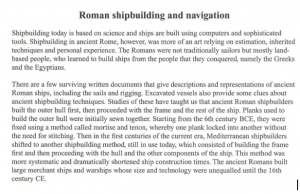
So, question 1 is FALSE. A simple case of being the other way around. The Romans didn’t pass their knowledge on to the Greeks and Egyptians. They “learned from them”. Pass on v. learn from.
Question 2 is more interesting. It’s NOT GIVEN. Nowhere does it explicitly state that the shipbuilders were “skilled craftsmen”. We might assume that of course and inevitably, what we bring to the text in terms of assumptions and previous knowledge may work for or against us. For example, in the first question, anyone with some knowledge of ancient history would assume it was the Greeks and Egyptians who passed on knowledge to the Romans. However, we don’t have to know that to be able to answer question 1.
Sample Not Given Question and Answer
Now, when it comes to the variant of Yes, No, Not Given, we are entering new territory. Here we are interpreting the writer’s points of view and that suggests that the language we are dealing with will be more complex.
Here, as an example, I’ve chosen from the same Cambridge IELTS 16 test series, Test 4, Reading Passage 2. Look at these questions. They refer to the last part of a very interesting text on the subject of reading titled: Changes in Reading Habits
- The medium we use to read can affect our choice of reading content.
- False information has become more widespread in today’s digital era.
Just to remind you here that the answer is Yes if the statement agrees with the writer’s views and it´s a No if it contradicts it. Not Given is when “it is impossible to say what the writer thinks about this”; in other words: insufficient evidence.
Read the relevant part of the text below.
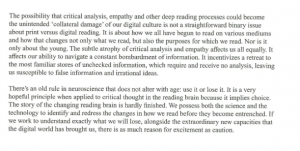
So, 23? The answer is YES.
But is it 25? The writer does suggest that we are more susceptible to false news but there is no mention whatsoever regarding the growth of false information. So, it’s Not Given.
It may be tempting for many of us who have been bombarded over the last few years with tales of fake news and concerns regarding the manipulation of truth through all kinds of means. It must be a “yes”, then? Beware of this distractor that deliberately plays with what we assume to be true or false without giving much thought to it.
Join many other students who have achieved success with our online IELTS prep course. Click here to enrol now.
You can download or listen to the audio version here:
| Direct Download Here | Stitcher | iTunes | Spotify |
Podcast: Play in new window | Download
Subscribe: RSS