

What is English grammar?
English grammar describes how meaning is programmed into words, phrases, sentences, and paragraphs.
Grammar defines the system behind any language. It governs how we combine words and interpret them. Languages evolve over time and so, too, will grammar.
Learning to speak English requires a growing knowledge of the parts of speech, tenses, clauses, and phrases.
We learn our native language without having to learn the “rules” of grammar, so it follows that the best way to learn English grammar is to listen, read and talk to others in English.

Learn the 9 parts of speech

Grammar consists of 9 parts of speech. The largest class is nouns and the second largest, is verbs. Understanding the parts of speech is a vital part of learning English grammar. This is because knowing the parts of speech will help you to understand how they behave.
Listed below are the 9 parts of speech
- Nouns – are the words used to name things, places, and people. Nouns fall into two types, common and proper nouns. Common nouns refer to things, people, and places in general such as pot, girl, and city, whereas proper nouns refer to specific places and people like London and Susan. Pronouns form a category of their own. A noun can be singular or plural.
- Adjective – adjectives are words that describe or “modify” nouns. Examples: The boy was happy, eating the sweet pickle. Adjectives can change to nouns. If you add “ness” to sweet, for example, it becomes a noun, sweetness. Adjectives usually go just before the noun that they modify.
- Determiners – a determiner is a word that introduces the noun and tells you more about it. When I say “your shoes” or “that person” you know exactly what noun I am talking about.
- Adverbs – adverbs describe or qualify a verb, another adverb, or a word group. They answer questions such as when and where. They describe the way things are done, as well as the place time, and frequency. The woman was quite sure that she had washed the windows properly.
- Verbs & verb tenses – verbs are action words. A sentence is incomplete unless it includes a verb. In the English language, there are main verbs and helping verbs. The following sentence contains just a main verb – The lion roars. Here are some examples of helping verbs “has”, “are” and “is”. Verbs change their form to indicate past, present, or future tense. This is called conjugation.
- Pronouns – a category of nouns, a pronoun replaces another noun in a sentence. Here, is an example. Mike saw Tracy and he smiled at her. “he” replaces “Mike” and “her” replaces “Tracy” in the sentence. You can imagine how clumsy the sentence would be without pronouns. Apart from the obvious pronouns such as I, us, we, they, and them. There are also several sub-categories of pronouns.
- Relative clauses – a sub-category of pronouns, relative clauses join two parts of a sentence. Examples include which, that, and who. I bought a car that is almost new. I met a boy who I liked.
- Preposition – a preposition links a noun to another word. Here is an example. The boys went to the park on Wednesday. These words typically describe the location in, besides, direction from, toward, or time since.
- Conjunctions – conjunctions allow us to write compound sentences. Without them, we would have to write a series of short simple sentences. These words include and, but, and yet. The boy finished school early, but he did not go home.
- Interjection – words that express an emotion like Ouch! Yay!
Practice verb forms
Understanding how verbs behave in past, present, and future tenses can present one of the most difficult obstacles for those new to English. While regular verbs are reasonably easy to conjugate. Typically, you would add a “d” to make it past and the word “will” or “shall” to change it to the future tense.
So Present; He bakes a cake.
Past He baked a cake.
Future He will bake a cake.
Simple right? The problem is that there are hundreds of irregular verbs that require special treatment. We have listed some examples below and how they change between present and past tense.
- Buy becomes bought.
- Make becomes made
- Run becomes ran
- Take becomes took … and so it goes.
The only way to learn the behaviour of irregular verbs is to practice as often as you can. With enough practice, the words will come naturally and without hesitation.
Your level of grammar

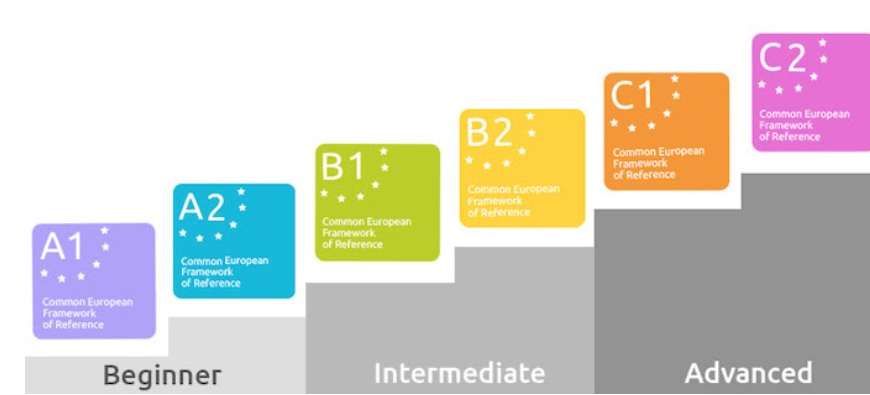
Knowing the commonly accepted levels of language proficiency will help you to recognize and celebrate progress as you learn English grammar. All of us go through these levels when we learn a new language.
Basic English Grammar a1-a2 CEFR
Students at an elementary level typically use elementary sentences and phrases for communicating basic needs. These may include the need for directions to various locations and information about shopping and working. Students at this level can introduce themselves and answer questions about personal details. They use simple sentences to get things done.
Elementary English Grammar
By the time the learner gets to this level, he or she can articulate simple ideas and can quite comfortably make his way around the area where the language is spoken. By this time, he can discuss ideas and issues within the home and work environments. He should be able to discuss or write simple texts about things with which he is familiar.
Pre-intermediate English Grammar
At this stage, the learner can understand English words, sentences, and phrases as they pertain to his work, school, or college environment. He can also write simple text on subjects with which he is familiar or which he finds interesting.
Intermediate English Grammar
Now the English learner can communicate abstract ideas in writing. His spoken language is fluent and English speakers can easily understand his conversation.
Intermediate to Advanced Grammar
At this level, the English speaker can understand almost everything he hears or reads. He can understand complex writing and converse fluently without having to search for words or expressions. His English grammar is so good that he can write texts and essays in a professional or academic environment.
How to improve your grammar on your own

“One day I will find the right words, and they will be simple.”
-Jack Kerouac
- Take some time to figure out the weak points in your English. Where to start? – Once you have assessed the current level of your grammar, you can plan methods to improve it.
- Set a target – knowing what you want to achieve and by when you will find getting there is easier.
- Create smaller goals – learning grammar is not easy. It takes time and plenty of practice. Set smaller achievable goals and celebrate the achievement of the goals with small rewards. This will keep you motivated and help you to continue to improve.
- Focus on one thing at a time. Grammar has many aspects. Trying to improve all aspects at the same will take you nowhere slowly. Compile a study schedule that separates the aspects. Then give yourself a reasonable amount of time to learn each.
- Do not judge your English learning success on your ability to learn English. Grammar can be very difficult to grasp so do not be too hard on yourself.
Tips and opportunities to learn English

● Watch to learn – have fun while you learn English. Take the opportunity to watch a series about something that interests you. Choose from fiction or non-fiction. Watching a movie is also a great way to improve your English.
● Talk to people – One of the best ways to learn English is to talk to native English speakers. They can also help you with pronunciation, which is a bonus.
● Read – every day. Reading is the best way to broaden your vocabulary. As you read, you will also become more familiar with the grammar.
● Use an app – there are plenty of mobile apps available that can help you to learn your grammar. Some of them will even link you to a native speaker.
● Ask for help – ask native speakers to correct you when you engage in conversation. This way you ensure that you do not perpetuate mistakes.

Improve Your English Grammar with these 11 sites
You may wonder how to improve your English grammar online. There are plenty of sites on the internet that offer English lessons. We have listed some useful sites below. There are also a lot of English grammar sites on YouTube.
●https://learnenglish.britishcouncil.org/grammar
●https://www.englishgrammar101.com/
●https://www.grammarly.com/blog/category/handbook/
●https://www.myenglishpages.com/site_php_files/grammar.php
●https://www.edx.org/learn/grammar
●https://www.passporttoenglish.com/English-Grammar.html
●https://www.learnenglish.de/grammarpage.html
●https://www.ef.com/wwen/english-resources/
●https://www.ego4u.com/en/cram-up/grammar
●http://www.englishpage.com/verbpage/verbtenseintro.html
Practice makes perfect
“Writing is an exploration. You start from nothing and learn as you go.”
-E. L. Doctorow

Learning English grammar is not that difficult. Though when you first start, you may think that you have bitten off more than you can chew, there is no substitute for practice when it comes to learning a language.
Use every opportunity to read, speak and listen to English. Podcasts, television shows, newspapers, books, and chatting with friends will all take you closer to the goal of becoming a fluent English speaker. The knowledge of English grammar is learned through practice. You do not have to think about the grammar in your native tongue. With enough practice this will soon be true for English.