I interviewed star student Bamidele, he got some great scores and generously shares how he did it!
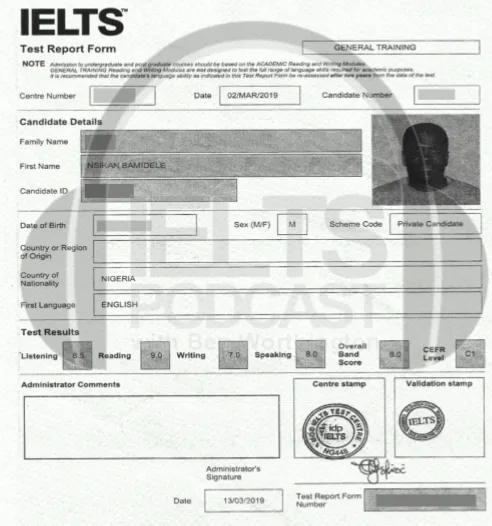
Look at these results:
Band 9 in the reading!
Hint, it’s all about the third passage!
Band 8.5 in the listening!
Bamidelle shares a super strategy you can try today! Hint: Listen to question 1, but look at question 2.
Band 8 in the speaking!
Hint use past, present and future in part 2.
Band 7 in the writing! (After Band 6 twice ?)
Hint: Don’t memorise essays, memorise structures! And use the recent IELTS Task 2 questions page!
Bamidelle took the IELTS to get to Canada.
He prepared using the materials at IELTSPodcast.com.
In the interview he shares exactly how he scored so well in each section. Trust me, each of his tips are very practical and most of them can be implemented today.
Listen to this tutorial with a pen, write it all down and try it out today!
|Direct Download Here | Stitcher | iTunes | Spotify | Soundcloud | Transcript |
You can also watch the full tutorial here:
READ THE TRANSCRIPT BELOW:
Bamidele: When I used all those words, the examiner was just laughing. He was so interested in my stories that he just said– after the exam, he said, “It was nice talking to you.” He gave me that compliment.
Female Voice: You are now listening to the IELTS podcast. Learn from tutors and ex-examiners who are masters of IELTS preparation. Your host, Ben Worthington.
Ben: Hello there IELTS students. In this podcast, we talk with Bamidele. He’s a very smart, energetic, and enthusiastic student from Nigeria and he shares how he got to band 9 in the reading. He says it’s all about the third passage in the text. Then he shares a very useful strategy for listening and he got 8.5 in the listening. This strategy is very practical actually.
In band 8, as you’ve probably just heard, he’s got a very interesting strategy for the speaking, which includes the tenses and stories and of course, he shares how he got band 7 in the writing after failing twice. Have a listen to this. It’s a very enjoyable interview. I enjoyed talking with Bamidele a lot.
Remember if you found this useful, share it with your friends or go to ieltspodcast.com and click like. I’ll be very grateful for that. Have a great day and just remember, you can pass this exam.
Hello there podcast listeners. In this tutorial, we’re going to talk with Bamidele and he’s a vet from Nigeria. Welcome to the podcast, Bamidele. How are you doing?
Bamidele: I’m very well. Thank you, Ben. How are you doing?
Ben: I’m good. I’m good. Why are you taking the IELTS exam?
Bamidele: Let me start from what actually inspired me to wanting to take the exam. It was purely for the purpose of immigration from the word go. How did that happen? I just discovered one of these days in the summer of last year that quite a number of my friends and colleagues at work have left the country.
Of course, we are on the same job, we are on the same salary scale, but then people are leaving the country. Then when you look at them, they get to talk about social security, get to talk about a new hold to life. Life offers them new opportunities to engage it. So, I thought that okay, it won’t be a bad idea if not for myself alone but for my children. My children should be given an education in a more secure environment, a more socially responsible environment.
Mind you not that Nigeria where I live and I was born is not a good place, but then, of course, security, social standards is a very, very big problem. So, if I can go to a place where in a few years, three years I can get a Ph.D., it wouldn’t be a bad idea. So, I felt getting a PR and becoming a Canadian ultimately was a goal. That was actually what inspired me in taking the exam.
Ben: So, you didn’t fancy doing it just because you had some time to kill?
Bamidele: No, no, it was basically due to the need for me to immigrate.
Ben: I’ve got you. I was just kidding. Excellent. What kind of pushed you to do it was not only the immigration like you said but your colleagues? A lot of them had upped stakes and gone to Canada as well. All just to Canada or Australia, UK, U.S. as well or just Canada?
Bamidele: Just one of them went for his Ph.D. in Australia. The rest of them permanently immigrated. They got their PRs and they are working and getting a new hold of life over there in Canada.
Ben: Interesting. How were you preparing for the IELTS exam before? How were you preparing for it while you were in Nigeria? I guess you are a self-study student. You didn’t go to an academy, did you?
Bamidele: I’m a self-study student. Interestingly, my IELTS study is very interesting. It real motivates some other people that are like me. I was born in Nigeria. I’ve been schooled with the English language, so to a very large extent I know that I got a very good grasp of the language. I know that fact, but attempting IELTS three times really, really, really onboard me.
It made me see that it’s more than speaking English. It’s more than writing good lexical structures. It’s more than you writing a thesis, you know. I’ve done academic thesis all my life. Of course, I’m a veterinarian, so I write a lot of research papers, but then writing the IELTS was a change in the narratives, you get?
The first one I attempted was in December of last year; December 1st last year general training test. Of course, the result was very good except that British Council said my proficiency in writing is a band 6.
Ben: That’s harsh.
Bamidele: Very harsh. For someone like me who had a 9 in listening, who had am 8.5 in reading, who had an 8.5 in speaking, then having a 6 in writing, it was a high level of insult to me.
Ben: Absolutely.
Bamidele: I felt really insulted. I felt really, really insulted. So, with that gusto I felt okay, you have insulted me this time around. In a month’s time, I’m going to take another exam. I’m going to sit another exam in a month’s time. So, January 5, that’s just like 34 days after I had the previous one I took another exam and it was a colossal failure.
Ben: Oh no.
Bamidele: It was unexpected. The failure was– I couldn’t explain.
Ben: Tell us, Bamidele, tell us what happened in the exam. Why did it fall to pieces? How did you end up with a 6? What happened? What happened when you were writing?
Bamidele: I think, like I said, I was overconfident that I knew how to write. I’m a good writer, I know how to write. I know how to use adjectives. I know how to use phrasal verbs. I’m very good with verbs, all right? I’m very good with paraphrasing, synonyms, so I knew that I was good doing those things. So, I just wrote. I just wrote and then the result came back. It was a 6; twice.
Ben: Wow! Hang on a second. Hang on before we get into the third one. I just want to break it down. You saw the question and then you just immediately started writing. You just jumped in two feet and started writing. Is that what was happening on the exam?
Bamidele: Not exactly. It looks somewhat like that but not exactly. In my case, it is advised that when you are given the paper to write, you should scribble some information down so that– scribble some information, your introduction, body paragraph 1, body paragraph 2, then the conclusion.
Just scribble, but I’m just very confident that I know offhand that, for example, discuss both views and give your opinion. I know that I will write the first opinion that agrees with the thesis statement, of course, probably the first proponent I write that part in the first paragraph. I write the other thoughts in the second paragraph then I conclude, but then I was just not following instructions until I stumbled on your blog.
Ben: Got you.
Bamidele: Until I stumbled on that blog. I can tell you that blog is a blessing, is a blessing. When I sent you a mail that I had passed, it was like a prayer because for me if I had not stumbled on it, probably I would just keep going round in circles, getting a 6, getting a 6.5 or maybe a 5.5 like I’ve seen in some very good English writers do. So for me, stumbling on that blog and watching thing– podcast, IELTS podcast was one of the best things that happened to me in this IELTS journey.
Ben: That’s super. That’s super. Can you tell– can you share with the audience which– if you remember, which tutorials– are we talking about the written tutorials on the site or the audio podcasts that you were listening to? Which were you using?
Bamidele: I used every resource that you sent via mail; every one of them. I engulfed them. I regurgitated them back to back.
Ben: Excellent. Excellent.
Bamidele: I did that, but the most interesting for me in your blog that I think you should keep doing, it was very helpful to me, the one that you’d bring recent questions. Questions from let’s say October and November, writing question samples then by January you bring November and December, like that. By March, you bring January and February.
Those resources were ultimately satisfying. I had a lot of satisfaction dealing with those question prompts that you gave. It opened my mind to see how to– know that anything can be asked in the IELTS. Anything can be asked. Anything. So, those questions that you shared made me have that conviction that anything at all can be asked.
Then following your essay structures are mind-blowing. They are mind-blowing. For me, I tell a student you cannot cram essays, but you can cram structures. Structures are beautiful.
Ben: Exactly. That’s a very smart point.
Bamidele: Exactly. The most helpful thing for me was your questions and then the structures that I followed because the major problem I had was writing. I was acing all other modules. I was doing well. I was scoring 8.5 in other modules, but then in writing it was just 6.
Ben: Yes, yes, that’s harsh. One thing, were you talking about the questions? Are we talking about the– I guess we’re talking about the writing questions. The speaking wasn’t an issue for you.
Bamidele: Writing.
Ben: Yes.
Bamidele: Writing specifically.
Ben: Yes, just for the listeners if you put into Google IELTS podcast recent writing questions, what’s happening there is that the students who take the exam, they’re sending in their answers. Also, we’ve got Nadyne who’s looking for questions that have been seen on the internet– that have been seen on the paper, recent exams and questions that have been posted online by other students and she’s collecting them all and putting them in one place. So, can you tell us how you used these questions? Did you just read them? Did you write essays for these questions? What did you do with these questions?
Bamidele: Yes, for my third attempt, for the first time I attempted writing essays. I was writing at least one essay every week. At least. That was at least. So, I would cross reference with people around me to help me check if there are grammatical errors, if there are punctuation errors, if there are wrong use of words, if there are grammar inconsistencies, if there are repeat of synonyms, repeat of words that we don’t have to use their synonyms.
Over the weeks, I interestingly got reviews from people, feedback and then I think I was good to go. Funny enough, let me just chip this in. A bulk of my preparation– you would agree with me that a bulk of the IELTS questions from October of last year they have been ‘discuss both views, give your opinion’. So, I mastered that question prompt like my second name. I had known it like my second name.
It’s been good, but funnily when I got to the third exam, it was ‘problem and solution’. That was exactly how I felt. I just laughed out. I laughed out so much so that the examiner was looking at what is wrong with this one that is laughing. I was expecting problem and solution question, but then it came and I was able to write. I was able to write. It was a very good experience.
Ben: Super. Super. I’m just imagining your laugh now. In the exam that must have been quite entertaining for the others as well. The structures, you said you got the structures– you got those from the mailing list, from joining the mailing list and then getting the emails. Is that correct?
Bamidele: Exactly. Exactly. That’s very correct.
Ben: Super. Super. Just to recapitulate for the students. What Bamidele did was he got the recent questions, he found the recent questions from ieltspodcast.com. Once they had been seen in the exams and prepared for those– and you said that you focused entirely on ‘discuss both views and give your opinion’. Is that right?
Bamidele: Exactly. That’s correct.
Ben: And you just mastered that one because you were convinced that this question structure– this type of essay question was going to appear on your exam. Correct? That’s what you believed.
Bamidele: Exactly. That’s correct.
Ben: Then when you got there you have the lovely ‘problem and solution’ which I think is probably a little bit easier. Would you agree with me?
Bamidele: That was why I was laughing. That was why I laughed out because it’s very easy. It’s very, very easy and the structures are very straightforward, general statements, paraphrase the topics and tense and in your own words then say your thesis statement like what you’re going to do. What that essay is going to do.
This essay will discuss possible solutions… will discuss the problems of so, so, and so including dash and dash and also discuss proper simple solutions including dash and dash. That is about everything that introduction is about. 60, 70 words you are good to go.
Ben: Yes, so true. So true. Then for the other areas, 8.5s and 9s, that’s really good. How were you preparing for those? How did you get those?
Bamidele: I think for me speaking has been my greatest strength followed by listening because by the kind of work I do, I listen to customer complaints a lot, so I’m used to listening to people.
Ben: Right, right.
Bamidele: At the same time, I’m used to talking to people. So, speaking and listening is always my strength from the word go. But I have some strategy I use for listening apart from the fact that you must listen for information.
Also, I know that for a time, you must be ahead of that audio in your mind. Your mind must be ahead of the audio. How do I get to do that? I don’t really know how to train people to do that, but I know that my eye is always looking at the following two questions, the succeeding two questions.
If I’m on question one, my mind is on two and three and my ears are on question one, my eyes are on two and three. My ears are on one. So when they mention something about question one, I write it down while my eye is working on two and three.
It’s a difficult strategy to do, but I think over time I’ve been able to master using my ears and my eyes independently. I’ve been able to do that very well. So that’s why it comes out as 9, 8.5 in my listening [crosstalk 00:19:17.11].
Ben: That is a fantastic strategy and just for the students that are listening, try this strategy. Try it a few times. Maybe do a few practice tests with this strategy. It’s similar to predict–
Bamidele: Ben, I won’t lie to you I did over a hundred listening tests, practice tests. I did over a hundred if I have not lost count.
Ben: Got you.
Bamidele: I did over a hundred.
Ben: Got you. Got you.
Bamidele: My strategy was I had six weeks to prepare for my last IELTS and I did a listening test every day in 6 weeks. That’s 42 tests. At least I did 42 tests. I had days that I did three listening tests. I had days that I did four. I had days that I did two, all right?
Ben: Got you. Wow!
Bamidele: So for me, my listening was the test that I prepared for the most.
Ben: Wow!
Bamidele: For my speaking, I got a strategy from you that you don’t even know that you gave me that strategy.
Ben: Hang on a second.
Bamidele: I got that strategy from you–
Ben: Hang on, hang on.
Bamidele: And that strategy was that–
Ben: Wait, wait, wait, wait, wait. No, no, no, no. Wait, wait, wait, wait. Just give me a second. Let me just rewind because we’re going a bit too fast. I just want to rewind and go back to the–
Bamidele: Sorry about that.
Ben: No, no, don’t worry. Don’t worry. What I was going to say with the listening is try that strategy and see if it works for you. If you’ve got the time, try it 42 times or 42 tests like Bamidele did, but also be aware that there are other strategies because each person is going to have to find a strategy that works best for them and there’ll come a point where you have to say okay, this strategy doesn’t work for me, I’m going to try another strategy. That’s what I wanted to mention.
Bamidele: Exactly.
Ben: Tell me about the speaking strategy that I gave you by accident.
Bamidele: Okay Ben, you know that for the speaking test that two minutes of discussion can actually look like two hours. Do you agree with me?
Ben: Yes, yes.
Bamidele: That two minutes comes across as two hours because when you’ve spoken for 30 seconds you discover that you are repeating words. I have noticed that in a lot of people. So, my strategy for that two minutes is whichever topic that you are given, whichever topic that you are given try and expand that topic.
Somebody will now ask me, how do I expand the topic? Talk about the topic in past tense. Talk about the topic in present tense. Talk about the topic in future tense. That means that you will be talking about three stories regarding that particular topic.
Ben: Excellent.
Bamidele: That strategy is full proof. It works perfectly.
Ben: Super. I love it. I love it. What happened on your speaking test? Can you remember the question? The part 2?
Bamidele: Yes, I can remember vividly. My two-minute question was, “Talk to us about somebody you love working with. Talk about someone you love working with. Who is the person. Where is the person? How has the person helped your task achievement?”
Ben: Interesting.
Bamidele: Those were the three question prompts. So, I just told the examiner that I will be talking to him about three personalities that have helped me achieve my goals.
Ben: Super.
Bamidele: One is in my past. In my primary school, I had a colleague that had unparalleled resilience in finishing homework and tasks. So, I really enjoyed working with him because he pushed me beyond my limits.
Ben: Wonderful.
Bamidele: I have talked about the person. I mentioned his name. I mentioned the time; that was my primary school. So, I have achieved that answer. I talked to the examiner about how he helped me. Resilience; he built resilience in me. No matter how tired he was as a child, he would tell you we have to do our homework before we go home.
Ben: Wonderful.
Bamidele: All right?
Ben: Yes.
Bamidele: Of course, somebody can ask me is that story true? It may be true, it may not be true. Do you understand?
Ben: I would put money on that it’s true because it sounded quite detailed. Is it true?
Bamidele: It is not true.
Ben: You tricked me!
Bamidele: It is not true. I made that story up. Then in my present, the present story I talked about my wife. My wife is an amazing personality to work with. She has a comical way of making very tedious or very hard jobs look very simple.
Ben: Is this true or is this another story?
Bamidele: Do you understand?
Ben: Hang on–
Bamidele: That is true. That is very true.
Ben: Okay, okay.
Bamidele: As a matter of fact, she taught me how to make culinary. She taught me how to make cakes. She taught me how to do a lot of fries and all that. So that is true. That is absolutely true.
Ben: Good, good.
Bamidele: So, I talked about someone in my future that I’ve not met before. I made up that name. The professor in a university in Australia who is a major kingpin in pharmacology, that I would like to work with him in future because I like his work ethic, I like his detailed thesis and I have been following him– I’ve been keenly following him with ardent enthusiasm. When I use all those words, the examiner was just laughing. He was so interested in my stories that he just said– after the exam, he said, “It was nice talking to you.” He gave me that compliment.
Ben: Very good.
Bamidele: “It was nice talking to you.”
Ben: Very good, very good. I like this idea that you said you’ve basically put a little bit more information there than what was required in the card because you said, “I would like to work with this pharmacology expert. I follow his work keenly,” etc. etc. and by doing that you can talk in the future tense, the future conditional “I would like…” That is super.
Bamidele: Exactly.
Ben: Wonderful strategy. Wonderful strategy. Good work there. I’m very impressed. That was a little nice touch from the examiner as well saying it was nice talking with you. That’s genius. Thank you for sharing that.
Bamidele: Thank you very much. You’re welcome.
Ben: Did you say you got an 8.5 or a 9 in the end?
Bamidele: In speaking, I got an 8. In reading, I got a 9. In listening, I got a 9. In writing, I got a 7.
Ben: Wow! Good scores there. Tell us about your reading score. How did you manage to get a 9? Was that through practice tests as well?
Bamidele: Reading I think for me– I think reading for me was basically because I know how to paraphrase. I discovered that any answer in the reading test is a paraphrase. Let me give you an example. If they talk about, “Which of these hotels– which of these accommodations has wireless service or has internet?” In the question, you will not see ‘internet’. You will see something like cellular. You’ll see something like Wi-Fi. You’ll see something like connectivity.
So if you’re looking for internet, you will not get that answer. You have to be able to paraphrase your keywords– paraphrase your keywords from the question prompts and again I have to really, really, really sound this to prospective students that want to sit the exam. It is best that you start your reading test from the third passage–
Ben: Wow! Okay.
Bamidele: –for three reasons. Reason number one is that the third passage is always the bulkiest.
Ben: Right.
Bamidele: It’s the bulkiest. The exam I did, the third paragraph had A-J. That’s how many paragraphs? A-J. A-B-C-D-E-F-G-H-I-J-K Eleven paragraphs.
Ben: Right.
Bamidele: It had eleven paragraphs, so you need a lot of time to study that paragraph. So, if you start from passage one, passage two, those are relatively simple passages. So, I always advise people– it has worked for me. I have scored an 8.5 in reading. I have scored 9.
So, I always advise people to start from the third paragraph so that the first reading is– because it is bulky. Those paragraphs are bulky and they are academic writing. They write them in academic language, so you need a lot of concentration to get through the passage.
The second reason for me is that at 20 minutes into the exam, the examiner will talk. “You have used 20 minutes of your time.” I don’t know [inaudible 00:29:19.21] but in Nigeria it’s like that. When you use 20 minutes, they will tell you have used 20 minutes. That is a very, very, very high level of distraction. For me– for that reason I want people to start from the third passage. If you have done your third passage with 20 minutes, when they talk in the second passage, you are not disturbed because those ones are simpler passages.
Ben: Got you. Got you. Interesting.
Bamidele: Then the third reason that I have is that if you run through the third passage first– there’s something in medicine that we call amnesia, an amnestic response. I will explain that. That means that I have seen this before. If you have seen something before, you are better prepared to deal with it.
So let me take it home. Meaning of what I said is that [unintelligible 00:30:22.03] it’s a second passage if you have an extra ten minutes, which I assume you will have if you are a fast reader, you will be able to go back to that third passage and then skim through and check out your mistakes. Because you have seen the passage before, it will not be new to you again.
Ben: I see, I see.
Bamidele: Those are the three reasons why I start from the third passage and it has worked for me.
Ben: Wonderful. How did you discover this? By doing multiple reading tests?
Bamidele: Yes. I discovered from multiple practice tests. Ben, let me tell you. I practiced like a junkie. When I want to do an exam, I practice like a junkie. My wife was making jokes the other time that you would hardly see a plain sheet in my house without you getting numbering of 1 to 40 there, that I have numbered 1 to 40 most of the books in my house. It was a joke, but the joke reflected how well I had read. How well I had done the listening test. I can’t lie to you. You cannot pass IELTS without practice. It’s impossible.
Ben: Absolutely.
Bamidele: It’s impossible. Absolutely. It’s impossible.
Ben: I totally agree with that.
Bamidele: Maybe you can have a 5 or a 6 or a 6.5 or a 7 maybe, but if you want to max out, score a 9, score an 8.5, score an 8, you’d have to become a junkie. Do it back to back to back to back.
Ben: Yes, that’s so true. That’s so true. Wow! Thank you. There’s a lot of value there. Now tell us, what are your plans now? Now that you’ve got your IELTS certificate, what’s the next stage? How are you going to get to Canada now?
Bamidele: Interestingly, IELTS was our limiting factor before because we had not passed our IELTS. My wife has passed since December. She passed the one we did in December. You know I’m the primary applicant for the Canada immigration, so I have to at least score a 7 in writing, at least a 7. So, that was what limited our progress, but immediately I got that result– the result came out 15th of March. The result came out 15th of March. I got into the express entry pool of Canada 16th of March. There was a draw 20th of March and we were drawn. We were given the invitation to apply for permanent residence and we’re on it right now.
Ben: Wow!
Bamidele: We are on the– we are at the very advanced stage of application.
Ben: Wow! That’s fast, isn’t it? That’s pretty fast and pretty lucky with the timings as well.
Bamidele: Yes, we’re lucky. We’re very lucky.
Ben: Wow! That is fantastic. Is there anything else you’d like to say before we finish up? Anything else you’d like to say to the students listening to the podcast?
Bamidele: I would like to tell people that failing an exam is not a failure–
Female Voice: Thanks for listening to ieltspodcast.com